what would be beat to organize customers info
We're experiencing neck-and-neck competition in the current state of the digital marketing world. 2020 brings new methods of leveraging data to make smarter concern decisions, now bachelor in the class of customer data direction software – and equally companies are quickly realizing – they produce measurable results. Just if those efforts are non well calculated, well thought out, and well aligned with your data management goals and functions, businesses of whatsoever size can find themselves drowning in this torrent of information.
As proclaimed past the famous direction good, Peter Drucker:
Peter Drucker
|
Management Expert
What gets measured gets managed - even when it's pointless to measure and manage information technology, and even if information technology harms the purpose of the organisation to do and so.
Essentially: don't waste effort measuring everything that moves. Instead, meaning free energy should exist spent determining what to measure, and what importance will be placed on the numbers.
Then, with data flowing in from every corner, what should be measured? Where should information technology be stored? How should it exist used to make valued business decisions?
And of course, the most difficult part of the procedure—where to start?
This article volition outline how to create a system of customer data management from scratch, including:
- What most companies are doing wrong when it comes to gathering data;
- Why companies still gather data this fashion;
- What these companies need to practise/have to gather data correctly in the hereafter.
And then where practise you brainstorm? Let'southward accept a look.
- Turn customer data into a disquisitional cantankerous-department knowledge base by employing a Customer Data Platform (CDP) that can be used to identify business organization intelligence, automate reports, and make audio business organization decisions.
- Collect the correct type of information (identity, quantitative, behavioral and qualitative) and coordinated around the client rather than aqueduct or device in society to obtain a complete, 360 customer view.
- CDP's real-time data streaming enables accurate, coinciding and reliable data that's easily available for straight consumption – displaying information in new forms for the purpose of analysis and selection exploration.
- Clarity in client data management provides a complete picture of what's going on, improving data identification and evaluation activities, and leaving very picayune room for guess work.
- Creating a holistic view of individual customers, the Single Client View establishes client centricity, harmonizes communication channels, and provides real-time operation monitoring.
- Exponea is the first GDPR-certified SaaS company, meaning customers can use the platform with the knowledge that its omnichannel communications capabilities remain in full compliance.
Setting the Scene
The key to company success now lies in the ability to triumphantly manage streams of client data. Though as the Harvard Business organization Review reports , virtually companies withal remain badly backside the curve:
- "Cantankerous-manufacture studies take shown that on boilerplate, less than half of an organization's structured data is actively used in making decisions—where less than 1% of its unstructured data is analyzed or used at all."
- "More than 70% of employees take access to data they should non."
- "fourscore% of a data analyst's fourth dimension is spent on just discovering and preparing data."
We're now faced with new challenges; be it cross-department communication, providing competitive customer experiences, or making critical decisions on the fly. Correctly gathering data on customer and users deliver huge benefits to organizations across all sectors – which is why companies plough to new solutions in information aggregation that improve that performance.
Client Data Management and How it Affects Us
Customer Data Management (CDM) is the procedure of gathering, organizing and analyzing data about your customers. Information technology's a crucial mechanism when considering improvements to:
- customer acquisition, satisfaction and memory rates;
- visibility of customers and advice strategies;
- and increased data quality and higher revenue.
That'south quite a repertoire, though once represented with the facts, the overwhelmingly positive results are hard to ignore. Still not convinced? Here's a breakdown on why creating a reliable customer database should exist your top priority:
- Acquiring new customers is no piece of cake job, yet a client database can drive your business organization communications without you having to spend a fortune on lame, detached advert.
Collect customer data by simply request for it and reward that trust by communicating relatable discounts, events and other promotional reminders (due east.thou. free shipping for first purchases). A pleasant first impression improves the likelihood of having clients become potent brand promoters.
- A whopping 80% of sales comes from 20% of your existing customers. In one case they're in your door, retain them past cultivating a salubrious client loyalty program which creates customized, positive experiences to produce recurring brand advocates that generate highly-valued word-of-mouth marketing.
Only with a fully operation client data management strategy can your marketing squad start calculating of import metrics similar client value over time, also known equally the Customer Lifetime Value (CLV) .
- Collecting relevant customer information will permit y'all to better segment your target marketplace, discover trends in buying beliefs and let you to customize individual communication strategies —leading to better-informed, real-time strategic determination-making.
- The customer's path to purchase can be a long, unpredictable process with multiple touch-points, numerous devices, around the clock consumption, and participation both online and offline. Relevant data collection class every stage of the customer journey can be analyzed to identify performers which can exist supported to enhance sales efficiency.
An underlying factor begins to stand out: for a client data management system to successfully produce results, data collection from various sources demand to be coordinated around the customer rather than channel or device, creating a holistic view of private customers called the Single Customer View (SCV) .
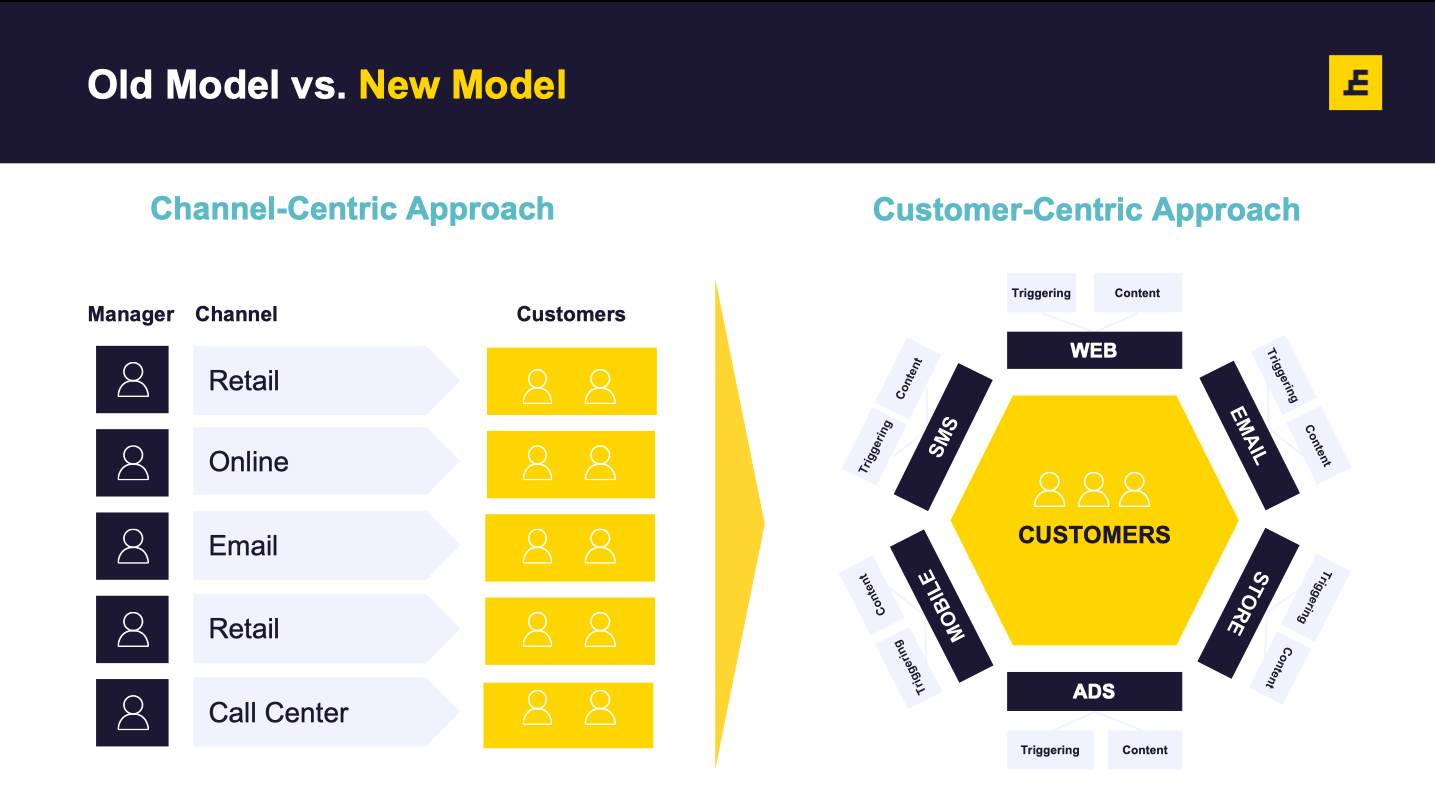
As a event, the newly centrally located and widely accessible customer profile is available throughout visitor departments as opposed to being warehoused in separate locations under lock and cardinal. Each client interaction is so relevant to their previous i, regardless of the aqueduct, encouraging consequent, transparent experiences with your brand.
Collect the Right Type of Data
Are you collecting the right blazon of customer information? A truly effective database needs to identify the type of information it'due south collecting, likewise as its value. We have this data divide into 4 key segments: Identity, Quantitative, Descriptive and Qualitative information samples. Below you'll find a description of each with examples, forth with ideas on how to collect them.
Author'due south Note
When collecting and storing data about your customers, you should consider the laws and legislation involved in the state and location of each client. There's no need to fret, nosotros've got you covered with our due east-book on GDPR compliance .
- Identity Information: By collecting the customer's identity data, we're able to uniquely profile the individual with the basic information needed to build a foundation, along with whatever contact details we need to reach out to them. Once the heir-apparent persona is comprised, communication tin can exist customized to their specific niche throughout their specific stage in the customer journey. Examples of identity data may include:
- Proper noun: Title, Start Name, Terminal Name, etc.
- Personal: Date of Birth, Region, Gender, etc.
- Accost: Shipping Address, Billable Address, etc.
- Telephone: Home No., Work No., Prison cell Phone No.
- Social Network: Facebook, LinkedIn, Twitter Accost, etc.
- Account: User IDs, Payment Preferences, etc.
How to collect Identity Data: Typically, you lot're already collecting this sort of information when your customers enter their payment details upon check out, sign up for your newsletter, or voluntarily paw it over in social club to receive a product, service, or incentive.
Depending on your industry, y'all may also consider:
- Tailored sign-upward forms
- Discount vouchers for commencement purchases
- Providing pre-order opportunities
- Tailored eCommerce checkout process
- Warranty cards
- Loyalty/rewards programs
- Quantitative Data Examples: Once yous're done getting to know the customer on an individual level, it's important to empathise how the customer is interacting with your business organisation using measurable operational data, or quantitative information.Sounds familiar? You're absolutely right. Quantitative data is data nerveless throughout the client journey, right down to discovery details, various channel interactions and conversion-specific steps that led to the purchase. Examples of quantitative information may include:
- Online/Offline Transactions: Product Purchased, Amount of Purchases, Fourth dimension of Buy, Order/Subscription Value, Social club/Renewal Dates, Cart Abandonment, Product Returns, etc.
- Inbound/Outbound Communication: Appointment, Fourth dimension, Aqueduct, Opens, Click Through Rates, etc.
- Online Activity: Website Visits, Product Views, Online Registration, etc.
- Social Network: Social Handles, Groups, Interactions, Interests, etc.
- Client Service: Complaint Details, Customer Query Details, Call Center Communication, etc.
How to collect Quantitative Data: The aim of the quantitative data game is to understand the decision making procedure of your customers every bit they interact with your company. What led them to find your business? Which aqueduct drives the most conversions?
Channel-specific tools are bachelor throughout the client lifecycle and should be tailored to measuring your marketing goals and strategy.
Where to starting time collecting quantitative data:
- Spider web Analytics Tools such as Google Analytics
- Website cookies/mouse-tracking heatmaps on landing pages.
- Tracking pixels in emails/newsletters
- Recording historical purchase transactions
- Recording historical customer support communication
- Social media activities
- Descriptive Data Examples: As a footstep upwards from identity data, descriptive data aims to collect additional demographic information that further outlines customer personas. Once clarified, y'all're ane pace closer to using predictive assay to implement optimal timing within your marketing efforts. Examples of descriptive information include:
- Family unit: Marital Status, Relationships, Number of Children, etc.
- Lifestyle: Holding Type, Car, Pet Ownership, Hobbies, Collections, Interests, etc.
- Education: High School, College, Advance Education, etc.
- Career: Chore Title, Chore Description, Income, Professional Groundwork, etc.
How to collect Descriptive Data: Obtaining high-quality descriptive data is no easy feat and requires additional ingenuity. Companies typically turn to in-depth questionnaires for their data collection, which dive into discovering seasonal growth and decline, buying behaviors, and lifespan of the customer bicycle.
Here are a few methods to collect descriptive information:
- Open-ended interview questions
- In-depth questionnaires and surveys
- Observations of target behavior
- Focus grouping interviews
- Avant-garde lead forms
- Qualitative Data Examples: Lastly, nosotros accept qualitative data, which should depict the reasoning behind the choices your customers make. Questions will typically start with How, Why and How, including "how opinions and attitudes are formed," why people behave the mode that they practice," and "what are the differences between social groups."Examples of Qualitative Information include:
- Attitudinal: Perceived Value, Rating, Feedback, Repurchase Likelihood, etc.
- Motivational: Reason for Purchase, Customer Needs, etc.
- Stance: Likes/Dislikes, Preferences, etc.
How to collect Qualitative Data: Approaching qualitative data collection can be a bit tricky, since collecting deep insight into customer habits is more fourth dimension-consuming, thus more expensive than merely collecting quantitative data.
Regardless, available methods include straight interaction on a one-to-one footing, direct interaction with individuals in a group setting, or indirect interpretation of customer opinions on various communication channels along the client journey.
Qualitative Data can exist collected in the following mode:
- Industry-related review websites
- Social listening with social media monitoring tools
- Tailored newsletter sign-up process
- Employing a favorite, save or rating system
- Deep listening and feedback form questions
These are just a few simplistic information categories to abide by, simply are not limited to industry-specific data that might be unique to your concern case.
As some may work ameliorate than others, a study performed by Ascend2 discovered that the most effective data sources were sales and customer service teams, quickly followed by marketing programs according to 50% and 45% of marketing influencers.
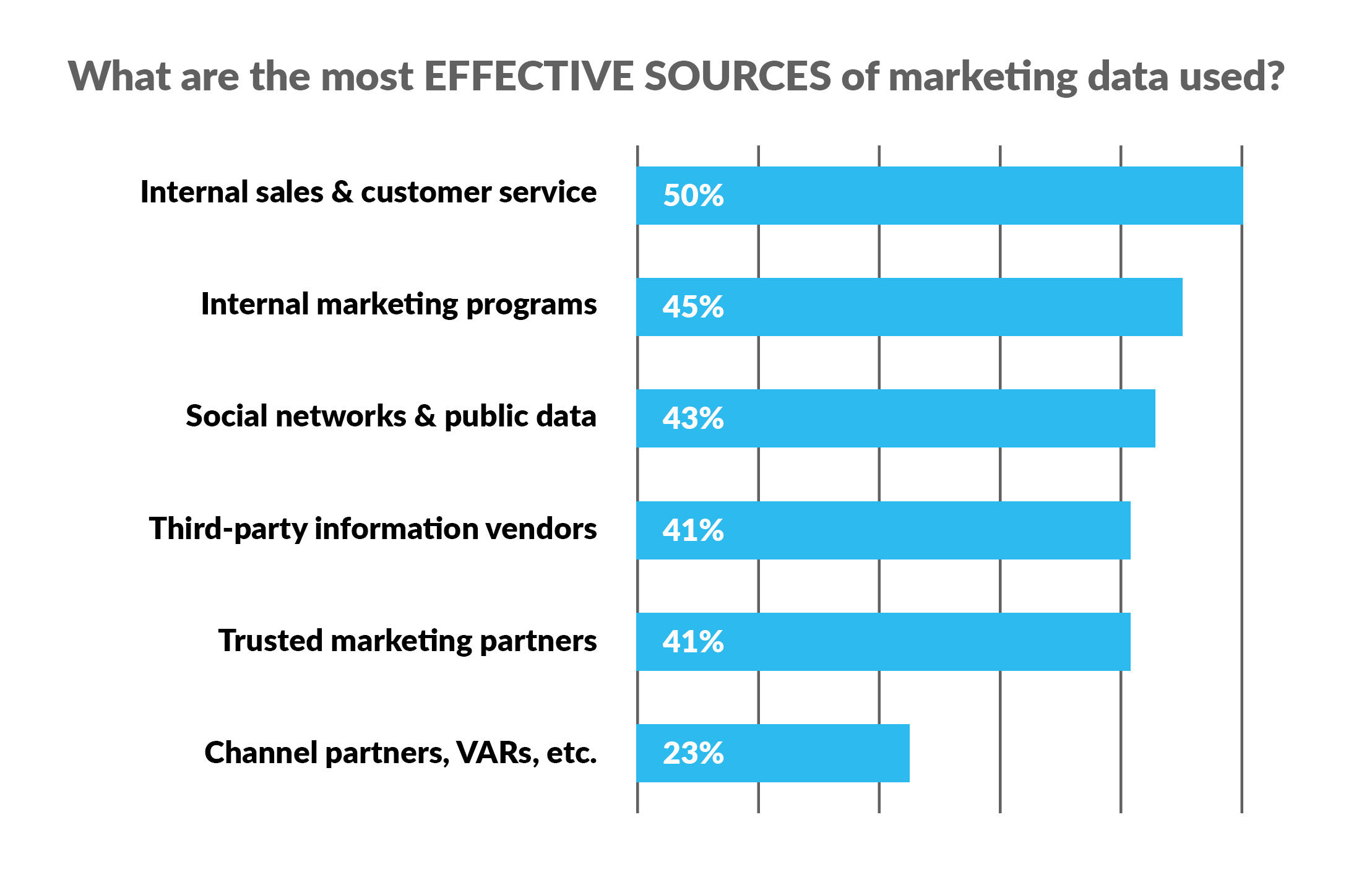
In other words, having your own customer data management platform – explicitly i that combines – is the most important source of marketing data for your visitor.
In the beginning, manually storing data on Excel sheets or like spreadsheet software may seem similar a depression-cost, reasonable solution. But every bit your concern grows, so does your data , and you might find yourself lost in the complex, voluminous data sets offered by today's large data trend — non to mention a lack of valuable insights that could give you a competitive advantage.
However, that'due south not fifty-fifty the biggest threat to your revenues. Overlooking initial customers and their Customer Lifetime Value (CLV) when overly focused on acquiring new ones is the real issue.
Regardless of the size of your customer base, it proves favorable to consider a tool that can
cultivate customer loyalty from the become-go. Employing such software early lets you retain initial customers and reward you lot with a faster shift from acquisition to the memory stage.
Sooner than afterwards you lot'll need efficient software to shop, track and brand sense of all the incoming information. Though information technology's just as wise to invest in the right tools from the starting time, rather than having to conform once you run into lost customers, poor reputations and the limitations of a spreadsheet. At that place'due south a wide variety of customer data management software bachelor to store customer data, but in terms of providing the personalization at scale that many consumers now look, there's 1 that stands out.
CRMs vs DMPs vs CDPs
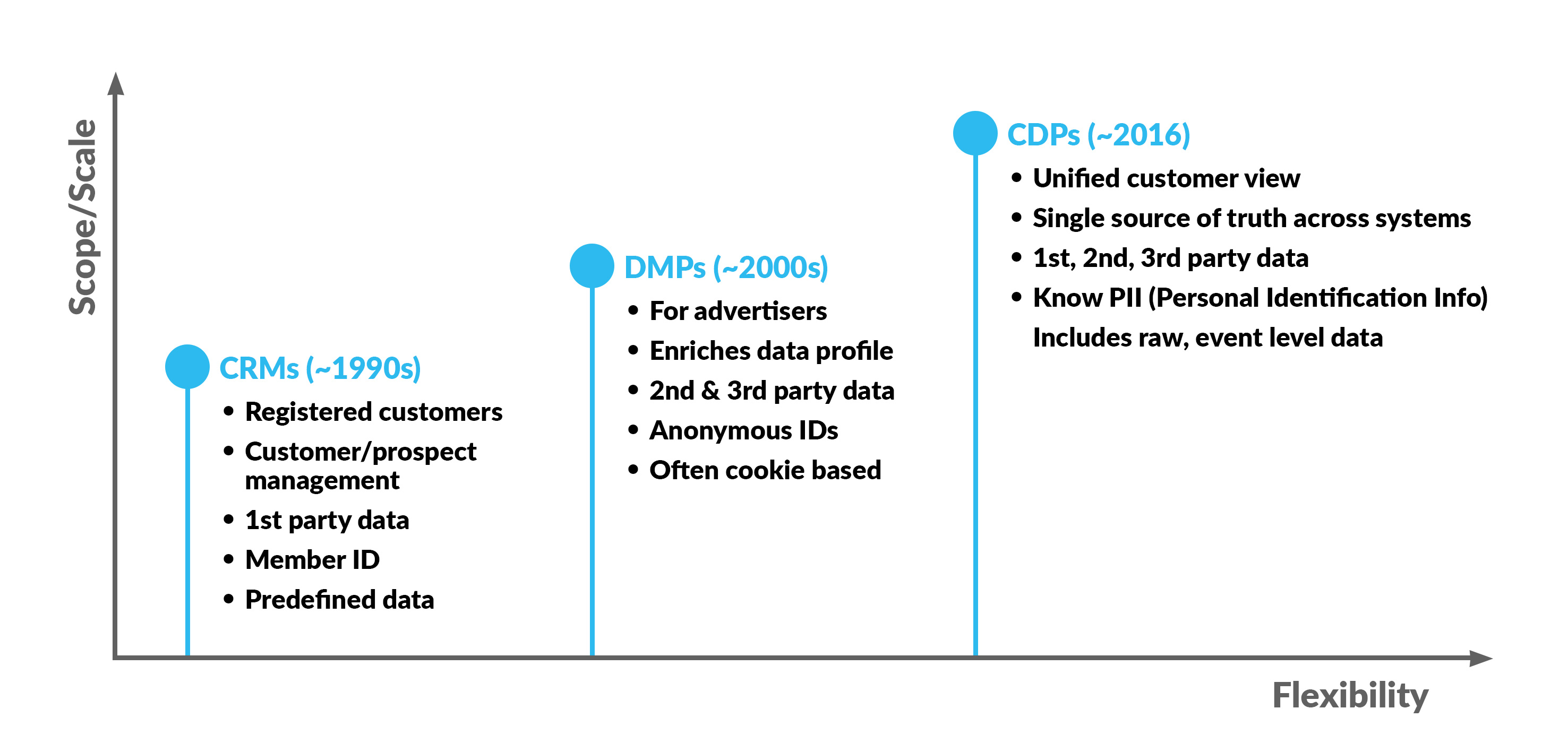
Historically speaking, Customer Relationship Direction (CRM) platforms were the outset data aggregation platforms to come up out in the 1990s. As a client data management system, their soul purpose was to collect known details (first-party data) about customer – think Identity and Quantitative information rather than Descriptive and Qualitative data – and managed these interactions.
CRM Pros:
- CRM platforms are congenital to engage with existing customers, gathering strategic information to fuel improved customer service, aid sales initiatives and improve informed marketing agendas. It's a start to having your information well organized and accessible among various departments to monitor customer interactions with your visitor.
- A CRM can quickly automize many marketing tasks, including pb creation from sign up forms and quick reporting. With an improved time management there's infinite to focus on more important details.
- Hands integrate a CRM with external tools to customize your marketing strategy and gather even more information.
CRM Cons:
- CRMs were never built to know about visitors before they get customers, making the Single Customer View a difficult achievement – and an admittingly expensive endeavor – when adding social media channels, advertising campaigns, web behavioral data, and other sources of data into the mix.
- Where CRMs lack about are existent-time capability, since they're nifty at managing tens of actions, thousands or even millions of times – but they aren't that adjustable. The more you customize them, the more messy and unmanageable they become.
Equally the cyberspace became more trackable in the 2000s, an alternative information aggregation platform came to the scene. Aimed to cater to advertisers through the use of cookies, the Data Management Platform (DMP) assisted with the planning and execution of media campaigns. Different CRMs, DMPs worked to unify anonymous IDs past using data sources that could be bought (2d- and third-political party data) rather than individually nerveless (first-party information).
DMP Pros:
- DMPs allow you lot to sew bits and pieces of second- and third-party data from cookies and other behavioral information to split up users into segments. These segments tin then quickly be put to use when personalizing media and dynamic advertising.
DMP Cons:
- DMPs only shop anonymous, third-party data with limited segmentation, and then they're heavily outperformed when dealing with more precise identity matching. Thus, creating a unified client view with multi-section sharing is completely out of the question.
- Data from DMPs are short-lived, based on the xc day lifespan of a cookie, and that'south non to mention how less effective cookies are subsequently GDPR legislation has taken effect.
- Integrating a DMP into your system'due south electric current environment might be challenging. It requires pregnant technical and domain cognition. Such data aggregation technology might plough out to be too complex for employees, introducing a steep learning bend associated with learning how to properly utilise it.
As the Big Data trend became abundant, so did the troves of data, creating a dire need for flexibility and calibration that could take on the demand for improved customer experience and omni-channel marketing initiatives . As the newest player amongst the aggregated information platforms, the Customer Data Platform (CDP) easily integrates with existing data, incorporating first-, 2nd-, and third-party information, also as offline and unstructured data, all in 1 organization.
CDP Pros:
- While CRMs and DMPs provide sectionalisation, CDPs centralizes all the customer data coming into your company, regardless of what channel or device the customer used. It organizes all the data you collect effectually the customer, rather than effectually the channel or device it was gathered from. The more than data sources you accept for the CDP to pull from, the more powerful it can be. A CDP is the beating centre of customer data that makes a Single Customer View possible.
- CDPs back up real-time data streaming to take firsthand activeness throughout the client journey, such as personalized recommendations, activating audiences and frequented cross- and up-selling opportunities. Flexibility at this scale tin can be applied to a wide range of channels and purposes, creating a more actionable marketing initiative.
- Built for Marketers – non Information technology Developers. The all-in-one nature of CDPs make it very easily integrated into the existing visitor surroundings, without the hassle of creating custom integrations on multiple modules. Having multiple data sources unified into a single source of customer information enables quick cross-department communication providing a connected client experience across all channels using the same interface.
CDP Cons:
- CDPs are driven by showtime-party data, meaning they well-nigh exclusively live off of the information collected by your marketing initiatives. Though it's more than personalized and based off of existent client information, this all has to be collected, and you might notice yourself lacking the quantity of data needed to run marketing initiatives at total steam.
- Contrast to DMPs, bug with express data sets further include the inability to purchase external information sources, such as second- and third-party information sets, to incorporate in marketing activities.
Here's a quick tally of our results:
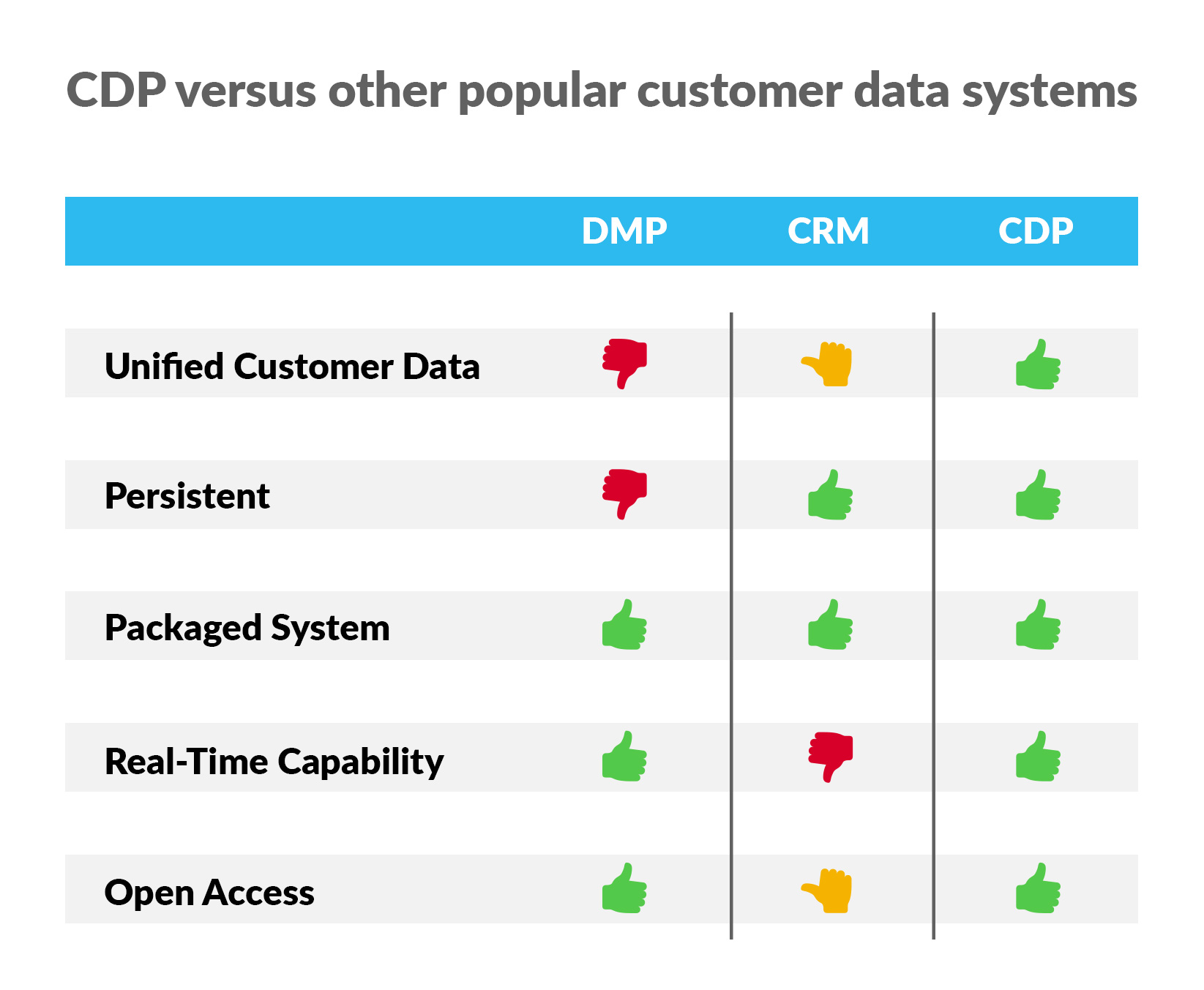
Every bit the table depicts, the most time- and price-efficient way to manage customer information, is to use an all-in-one Client Data Platform.
Decision
An extensive customer database cannot be built overnight – it takes some time and try from the business owner to get together the correct type of data, detect the right method of storage, and apply the necessary safeguards for right use. If washed correctly at present , over time this information will become an asset to your business, helping yous abound and succeed in your endeavors – if ignored, it could come back to bite.
Information technology'south at present considered commonplace for customers to expect a personalized customer service. And so why non provide a consistent cross-channel client feel with appropriate recommendations, and tailored communications? It'southward much easier to retain existing customers, than to fight to get them back.
This is why it'due south and then crucial to have a well-maintained, accessible and insightful Customer Information Management system – and now, a good Customer Information Platform can make that possible.
Exponea is a customer experience and client information platform that not but boosts east‑commerce growth with AI powered engagement automation, but also helps improve our clients' culture with better cross‑department collaboration and customer centricity.
86% of customers are willing to pay more for a better customer feel. Give them what they want.
encounter the author
Robert Heger
Entering Content Specialist
Robert is the Inbound Content Specialist at Exponea, where he spends much of his time researching and writing to create Exponea's articles and east-books. Robert'south previous experience revolved around project management, business strategy and innovation. With Exponea, Robert has been leveraging his talents for the earth of eastward-commerce.
cunninghampeenionved.blogspot.com
Source: https://exponea.com/blog/customer-data-management/
0 Response to "what would be beat to organize customers info"
Post a Comment