what is the doterra equivalent to young living exodus ii?
by Robert Tisserand
Update 12/thirteen/2017: Nosotros are very pleased to see that since the publication of our blogpost, 6 companies have changed their safety guidelines! Eden Botanicals now has 0.07% as the recommended dilution for Cinnamon Bark oil, and Organic Infusions, Nature's Gift, Ananda Apothecary and Barefut. all give 0.one% as the maximum. All of these are in line with our recommendation – congratulations to those companies! See the table below for updated information.
The importance of dilution earlier applying essential oils topically is being increasingly recognized by both consumers and corporations, and yet "dilute before use" or similar is insufficient safety advice for some essential oils. Diluting cinnamon bawl oil to 20% for example, may non protect yous if information technology needs to be diluted to 0.1% to avert an agin reaction.
Full Cinnamon Survey Special Report Bachelor for auction hither.
Risk vs do good
Adverse reactions to herbal preparations are every bit old every bit plant medicine; Dioscorides refers to several in his herbal text, written 2,000 years agone. And possibly it makes sense that if something is a strong medicine, and so it may cause issues for some people. Cinnamon bark oil is quite a stiff substance, due to its loftier concentration – effectually 80% – of cinnamaldehyde. Some of the outstanding backdrop of cinnamaldehyde are highlighted below, along with the number of research articles (citations) plant in the medical database PubMed in October 2015.
Cinnamaldehyde research on PubMed
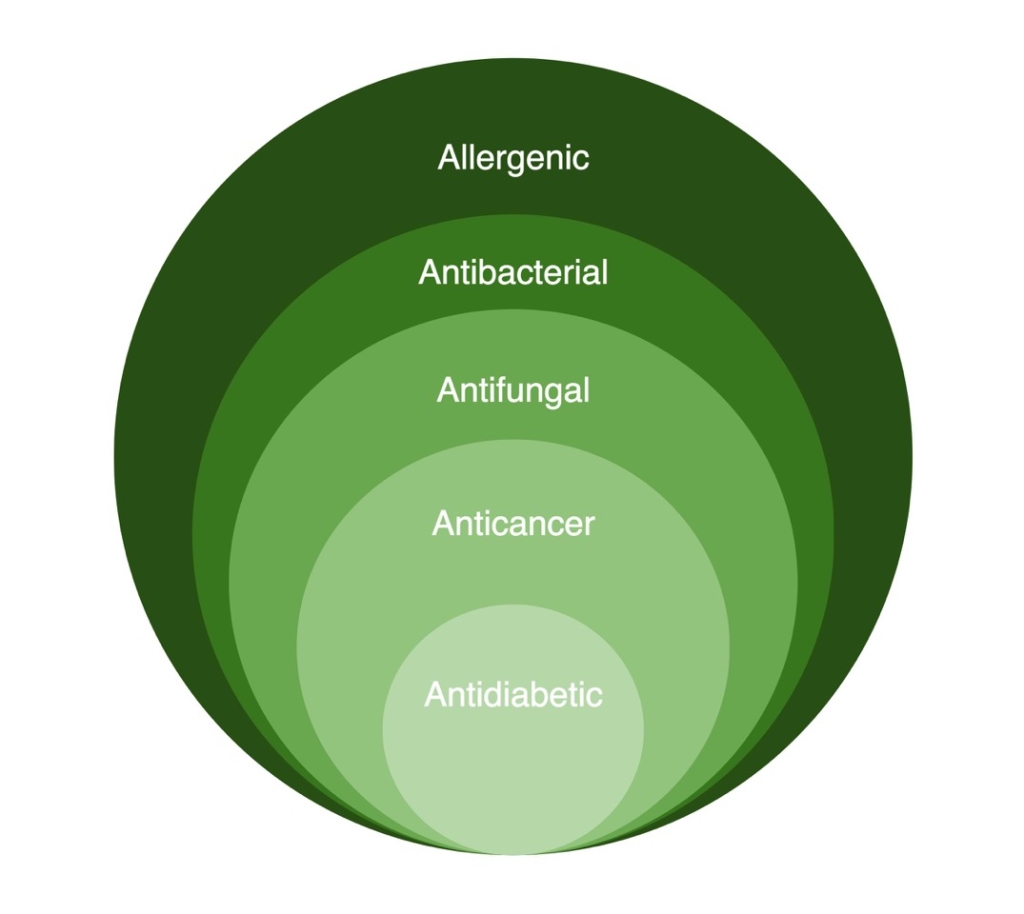 Topically allergenic / irritant
174 Citations
The downside.
Antibacterial
134 Citations
Ane of the most potent antibacterial constituents in essential oils.
Antifungal
111 Citations
A very potent antifungal also.
Anticancer
79 Citations
No human trials, only this strongly suggests a potential.
Antidiabetic
xx Citations
Promising research, some clinical.
Cinnamaldehyde has some beneficial properties, but allergies are undesirable, so the challenge is to place a dose or dilution that is effective, and also safe for at least 99% of us. Since nothing is totally risk-gratuitous, this may require a trade-off between risk and benefit, but generally, we look to minimize risk. And allow's be clear about one thing – if we're going to assume that the benefits of cinnamaldehyde utilize to cinnamon bark oil, which is quite reasonable every bit it'due south 80% of the oil, then we as well have to presume that the agin effects of cinnamaldehyde employ to cinnamon bawl oil. If yous want to rule out the research on agin effects considering the cinnamaldehyde used in the inquiry was made in a lab, or considering the tests were done on isolated cells or animals and not humans, well then that will also rule out most of the good stuff.
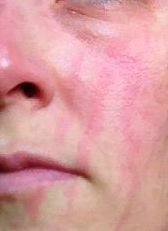
Adverse reaction to an extremely low dilution of
cinnamon bawl and peppermint oils in a shampoo
Also, the adverse reactions being discussed here relate to the pare, and we have non explored the potential for cinnamaldehyde-rich oils to irritate mucous membrane, though there certainly is such a potential. In a review of cinnamon, cinnamon oil and constituents, Navabi et al (2015) comment: "Despite the above reported studies that promote the utilise of cinnamon applications in nutrient and corrective products, the oral ingestion or skin application of cinnamon or its components (i.e. cinnamaldehyde, eugenol and cinnamic acrid) is not always advisable and is recommended only in very small doses."
Haptens and agin reactions
In the aromatherapy world, the almost common type of adverse reactions are skin reactions to topically applied oils. Adverse skin reactions (ASRs) are also one of the about obvious types of adverse event – when it happens you tin feel it, and others can see it. ASRs are divided into four broad categories:
1. Irritation (irritant contact dermatitis)
ii. Contact urticaria (immediate hypersensitivity)
three. Allergic contact dermatitis (delayed hypersensitivity)
4. Photosensitivity/phototoxicity
It has been said that information technology's impossible to have an allergic reaction to essential oils, because they exercise not contain proteins, and only proteins can cause allergies. However, an allergen is a substance, poly peptide or non-poly peptide, capable of inducing allergy or specific hypersensitivity.
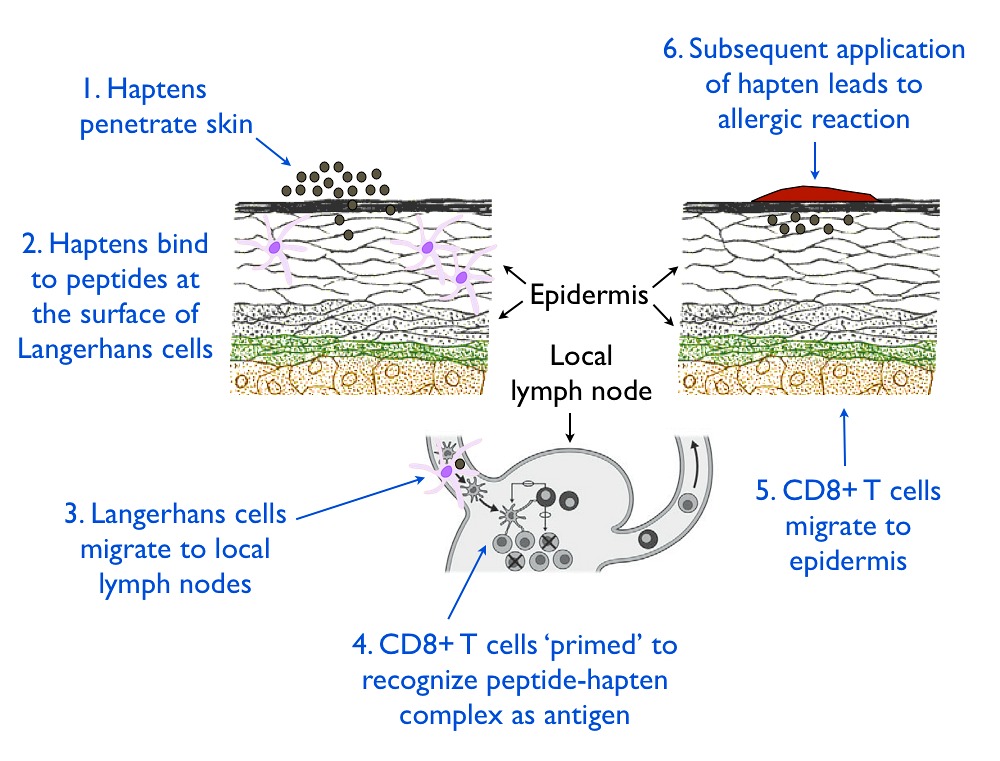
The process of haptenation and allergic reaction
Our allowed system can't recognize very small molecules such as those found in essential oils just, mayhap unfortunately, haptenation gets around this. The concept of a 'hapten' emerged from a series of manufactures past Landsteiner & Jacobs beginning in 1935, and is Greek for 'to fasten'. Some essential oil constituents, such as cinnamaldehyde, can cause allergies because they are haptens. This ways that they are 'protein-reactive'; they bind with proteins in the skin. More specifically, they bind with peptides (short chains of amino acids) on the surface of Langerhans cells, and the Langerhans cells then migrate to local lymph glands, where the peptide-allergen complex is presented to T-lymphocytes. Antibodies are then created, and the next time the same hapten contacts the skin, an allergic reaction is almost inevitable.
Cinnamaldehyde is the most widely studied essential oil allergen. We know for example that it activates a signaling system in Langerhans cells, and this is what causes them to become active and drift from the epidermis to local lymph nodes (Ouwenhand et al 2008). This migration is an essential step in the allergenic procedure.
Irritation reactions are quite different to allergic reactions, as they exercise not involve the adaptive part of the immune system. If your skin becomes inflamed after applying an essential oil, applying a vegetable oil may aid to at-home downwards any type of adverse reaction, especially an irritant one. However, if you have had an allergic reaction you lot cannot take away the antibodies you now have. You have acquired an allergy to an essential oil constituent, for life. Topical allergies sometimes do fade, in a similar way that y'all may need a boost for an immunization after x or 20 years because your immune system no longer produces antibodies. But usually information technology's that kind of fourth dimension scale – decades. And it might never fade. Better than waiting to see if your pare becomes inflamed is to prevent it from happening at all, and the all-time way to do this is to empathise appropriate dilution.
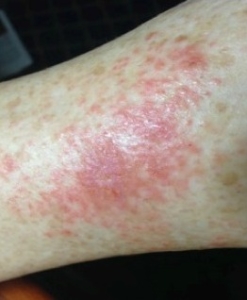
Agin reaction, probably allergic, to 'slightly diluted' frankincense oil
Our cinnamon oil survey
The Tisserand Plant conducted a survey in gild to find out more most ASRs to essential oils as used past aromatherapy enthusiasts, and I co-authored the subsequent Special Written report with Kelly Ablard and Christine Carson. We selected cinnamon bark and cassia oils for this survey since both are high in cinnamaldehyde, and this elective is regarded as a potential irritant and allergen by dermatologists. Since 1995, 270 of xiv,007 dermatitis patients who were patch tested with a 1% concentration of cinnamaldehyde had an adverse reaction to it (See Cinnamon Survey Special Report). That'southward a little under two% of those tested, and this makes cinnamaldehyde the most high-hazard essential oil constituent known from patch testing (Tisserand and Young 2014, p93).
At that place are accounts in the dermatology literature of adverse reactions to cinnamon bawl oil practical to the skin. Repeated employ of diluted cinnamon oil has acquired allergic contact dermatitis (Ackermann et al 2009, Calnan 1976, Sánchez-Pérez and García-Díez 1999), and use of undiluted cinnamon oil has caused irritation (Perry et al 1990). One case was then astringent that it was classed equally a second degree chemical burn (Sparks 1985).
Click image for 16 page survey study
In our survey, we establish a very high incidence (27%) of reported agin reactions to cinnamon bark or cassia essential oils, and we institute that using undiluted essential oil on the skin did increment the risk of agin reaction. Some other chance factor, also as dilution, is frequency – the more ofttimes you apply the aforementioned substance, the greater the risk. This combination of chance factors seemed to be borne out in the results of our survey,
Our survey did not directly address the issue of why 1 person can use undiluted cinnamon bark topically and not experience an adverse reaction, while another will react to a 5% dilution. However, nosotros did find an interesting correlation. We found that people with seasonal allergies are half dozen times more than prone than boilerplate to adverse skin reactions to cinnamon bark and cassia essential oils. There may perchance be a genetic reason for this.
Our findings suggest that, for many brands, there are bereft safety guidelines on the labels of these essential oils. Label information was not part of our survey, but we believe that advising non-specified dilution, which seems to be mutual, does not provide sufficient protection for consumers for these two oils. Based on our survey results, we suggest that a recommended maximum dilution of 0.1% should be adopted within the aromatherapy industry. That's equivalent to one drop in 30-forty ml.
What cinnamon oil retailers in the U.s.a. currently recommend
For the purposes of this weblog post, I looked at xxx retail suppliers of cinnamon bawl oil, to see what condom advice for topical application was given online (Table 1). I found that more often than not at that place is a very high level of awareness that this essential oil presents some hazard, with two out of three referring to it as a potential irritant or sensitizer. No supplier seems to suggest that dilution is not required before application to the peel. However in this list, only the offset 19 (63%) either prohibit use on the pare completely, or specify a dilution. The remaining 11 suppliers (37%) recommend diluting the oil, but without stating past how much.
Information technology's articulate from this exercise that there is an enormous range of recommended dilutions being given, including 0.07% and xx% – a difference of nigh 300 times. I believe this needs to change, and I am especially concerned that the ii largest retailers, Young Living and DoTerra, are among those that just suggest non-specific dilution.
Tabular array ane: Retail suppliers of cinnamon bark oil and online safety guidelines
| Visitor name | Safety guideline | Comments (click for link) | |
|---|---|---|---|
| one | NOW | Do not use on skin | "Do not use on pare" |
| two | Mountain Rose Herbs | Do not use on peel | "Do non use on skin" |
| 3 | Camden Greyness | Do not employ on skin | "Not recommended for topical use." |
| 4 | Hopewell Essential Oils | 0.07% | "Strong skin irritant for all ages. Dilute 0.07%." |
| 5 | Stillpoint Aromatics | 0.07% | "Maximum dermal level: 0.07%. This dermal maximum is based on 75.5% cinnamaldehyde content with a dermal limit of 0.05%" |
| 6 | Eden Botanicals | 0.07% | The company changed their guidelines based on this post: "maximum dermal use level is 0.07% based on (East)-cinnamaldehyde and safrole content" |
| 7 | Eden's Garden | 0.07% | "Dilute to 0.07% when using topically. Using more that the recommended dilution can cause adverse reactions such every bit … sensitization." |
| 8 | Nature's Gift | 0.ane% | The company changed their guidelines: "keep the dilution extremely low (0.1% the equivalent of One DROP in 30 – forty mls" |
| 9 | Found Therapy | 0.ane% | "We recommend a maximum dilution of 0.one% for topical applications." |
| 10 | Aromatics International | 0.1% | "Cinnamaldehyde makes it virtually impossible to apply on the skin… When using in a skin blend, only utilize one drop per twoscore mls." |
| 11 | Organic Infusions | 0.1% | The company changed their guidelines: "According to Robert Tisserand, the author of Essential Oil Safe, suggests that a recommended maximum dilution would be no more than 0.one% earlier applying to the skin." |
| 12 | Ananda Apothecary | 0.1% | The visitor changed their guidelines: "If practical topically, it MUST BE SIGNIFICANTLY DILUTED TO LESS THAN 0.1%. " |
| 13 | Barefut | 0.ane% | The visitor changed their guidelines: "Dilute properly with a carrier oil prior to topical applications at a maximum dilution of 0.1%." |
| fourteen | Amrita | 0.2% | "You must highly dilute this oil before using on the pare, up to 0.ii% maximum; otherwise information technology would cause severe irritation." |
| 15 | Floracopeia | Less than 1% | "Cinnamon oil is a mucous membrane irritant and potent skin sensitizer. Use only in very low dilution (less than 1%)." |
| xvi | SunRose Aromatics | Less than 1% | "Cinnamon Bawl is a known sensitizer and an irritant. Practise NOT use on the skin (i.e. peel care products, massage blends). Should you need to apply this oil in a therapeutic blend exist sure to keep the dilution extremely low as in less than 1%!" |
| 17 | Piping Rock | one% | "eight-10 drops of essential oil per 1 ounce of carrier oil." |
| 18 | Gritman | 1% | "Skin irritant use in a ane% or less dilution." |
| nineteen | Améo | 20% | "Possible pare sensitivity…Dilute to twenty% Cinnamon oil and 80% Améo Fractionated Coconut Oil." |
| xx | Jade Bloom | 20% | "Safe to use with heavy dilution (four to one)" |
| 21 | The Oil Shoppe | 20% | "Dilute 1 role essential oil with 4 parts carrier oil… This oil may exist a stiff pare irritant (skin may redden or fire), so be sure to dilute with carrier oil." |
| 22 | Young Living | 20% | The The states website states: "Dilute 1 drop with iv drops of V-6™ or olive oil."Different safety guidelines given for Australia (do not apply topically) and Europe (5 drops in 10 ml – 1.7%) |
| 23 | Essential Oil Substitution | Dilute | "The bark oil is a dermal toxin, irritant and sensitizer. Use in extreme dilution." |
| 24 | DoTerra | Dilute | "Topical utilise: Dilute one to two drops with dōTERRA Fractionated Kokosnoot Oil then use to desired area. Possible skin sensitivity." |
| 25 | Oshadhi Usa | Does not carry Cinnamon bark in US | The official US website does not carry Cinnamon Bark essential oil. The UK website states: "Only apply in depression doses" |
| 26 | Native American Nutritionals | Dilute | "Hot oil, use small amounts diluted… Always dilute with carrier oil." |
| 27 | New Directions Aromatics | Dilute | "Dilute well before utilise; for external use but. May crusade skin irritation in some individuals." |
| 28 | Snow Lotus | Dilute | "Properly dilute all essential oils in lotion or vegetable carrier oil before massage or other topical use." |
| 29 | The Essential Oil Company | Dilute | "It is not recommended to utilize directly on the peel considering it tin can be irritating although may exist used as an additive in lotions and massage oils in small amounts." |
| 30 | Majority Apothecary | No safety recommendation | No safety information listed for Cinnamon bark oil (here) |
Table 1 includes retailers based in the USA. It may not be a complete listing, but it is representative of the range of guidelines given for cinnamon bark oil. This information was obtained from online searching, and information technology is possible that product labels take different guidelines.
The importance of essential oil dilution
There are rubber guidelines that exist in order to minimize ASRs. The International Fragrance Association (IFRA) has a voluntary code for the fragrance industry, and began issuing guidelines in the early 1970s. These are based on testing carried out by a sister organization called RIFM, which includes tests on panels of human volunteers. For example, patch testing on a panel of 25 volunteers by RIFM using cinnamaldehyde produced reactions in two of the 25 when tested at 0.five%, but 11 people when it was tested at a 2% dilution (Opdyke 1979). This is considering ASRs are dilution-dependent; the greater the concentration of the substance on the skin, the greater the gamble.
Safety guidelines exist to protect those who would probable have an adverse reaction, and in many cases this is a minority. Whether it's 1%, 5% or 10% of people it'south a minority, meaning that most will non experience that particular adverse reaction. This of course does not mean that a safety guideline is wrong or can be ignored. In recent years, I have come across many reports of adverse pare reactions from aromatherapy enthusiasts applying undiluted essential oils topically. These reactions may not happen for a while – weeks or months in some cases, and maybe never – but if and when they do, they are not pleasant.
Using undiluted essential oils on your peel may exist reasonable for some essential oils, for some problems, and for some people. Only mostly it'south not a good idea considering of rubber issues. Using concentrated essential oil may not fifty-fifty exist useful, just it depends on what you are trying to achieve. Tabular array 2 is a full general guideline for essential oils, which should proceed you equally prophylactic as possible while retaining therapeutic effect. There are also guidelines for loftier-risk essential oils such as cinnamon bark, likewise as for specific age ranges, which can be plant in Essential Oil Condom.
Table two: Full general guideline for essential oil dilution
| End apply | Dilution range |
|---|---|
| Facial cosmetics | 0.ii-1.5% |
| Body massage | 1.5-three% |
| Bathroom & trunk products | 1-iv% |
| Specific problems | 3-ten% |
| Pain, wounds | 5-xv% |
| Acne lesions, insect bites, fungal nail infections | 25-100% |
Dilution cannot be overemphasized when information technology comes to all essential oils, just is especially important for cinnamon bawl and cassia. A little really does go a long manner and if you lot proceed with caution, you may exist able to benefit from some of the amazing properties of these oils for longer, and with no adverse reaction.
References
Ackermann 50, Aalto-Korte K, Jolanki R et al 2009 Occupational allergic contact dermatitis from cinnamon including one case from airborne exposure. Contact Dermatitis 60:96-99
Calnan CD 1976 Cinnamon dermatitis from an ointment. Contact Dermatitis 2:167-170
Dietz Fifty, Kinzebach S, Ohnesorge Due south et al 2013 Proteomic allergen-peptide/protein interaction assay for the identification of human peel sensitizers. Toxicology in Vitro, 27:1157–1162
Elahi EN, Wright Z, Hinselwood D et al 2004 Protein binding and metabolism influence the relative skin sensitization potential of cinnamic compounds. Chemical Enquiry in Toxicology, 17:301–310
Landsteiner Thousand, Jacobs J 1935 Studies on the sensitization of animals with simple chemical compounds. Journal of Experimental Medicine 61:643-656
Nabavi SF, Di Lorenzo A, Izadi Grand et al 2015 Antibacterial effects of cinnamon: from farm to nutrient, corrective and pharmaceutical industries. Nutrients 7:7729-7748
Opdyke DL 1979 Monographs on fragrance raw materials. Food & Cosmetics Toxicology 17:253-258
Ouwehand G, Santegoets SJ, Bruynzeel DP et al 2008 CXCL12 is essential for migration of activated Langerhans cells from epidermis to dermis. European Journal of Immunology 38:3050-3059
Perry PA, Dean BS, Krenzelok EP 1990 Cinnamon oil abuse past adolescents. Veterinarian & Human Toxicology 32:162-164
Sánchez-Pérez J, García-Díez A 1999 Occupational allergic contact dermatitis from eugenol, oil of cinnamon and oil of cloves in a physiotherapist. Contact Dermatitis 41:346-347
Sparks T 1985 Cinnamon oil burn down. Western Journal of Medicine 142:835
Weibel H, Hansen J 1989 Interaction of cinnamaldehyde (a sensitizer in fragrance) with protein. Contact Dermatitis 20:161-166
Total Cinnamon Survey Special Report Available for sale here.
cunninghampeenionved.blogspot.com
Source: https://tisserandinstitute.org/new-survey-reveals-dangers-of-not-diluting-essential-oils/
0 Response to "what is the doterra equivalent to young living exodus ii?"
Post a Comment