Furled Flag Clip Art Combined Branches Military Service Symbol
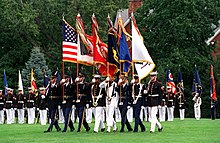
The several branches of the United States War machine are represented by flags. Inside the U.Due south. military, various flags fly on various occasions, and on various ships, bases, camps, and war machine academies.
In general, the order of precedence (from viewer's left to right) when displaying flags together in a armed forces context is to display the U.S. national flag (also known equally the "colors" or "national colors"), followed by the flags of the U.Due south. Army, U.S. Marine Corps, U.S. Navy, U.S. Air Forcefulness, U.S. Space Forcefulness, and U.S. Coast Guard.[ane] [2] [3] If the U.Southward. Declension Guard is transferred to the Department of the Navy, the U.S. Coast Baby-sit flag would precede the U.S. Air Force flag.[4] [v]
Service flags [edit]
Maritime flags [edit]
Many maritime flags accept been used in the The states.
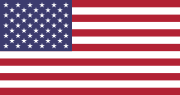
All maritime vessels and naval warships belonging to the Usa (with a few exceptions such as U.S. Coast Guard vessels) wing the ensign of the United States, which is identical to the national flag of the United states (though originally was a pattern similar to the G Spousal relationship Flag). All documented U.S. vessels, and all U.S. vessels in international or strange waters, are required to display this ensign between 08:00 and sunset. Conversely, vessels of the U.South. Coast Guard display a unique ensign as a demonstration of its authority to cease, board, search, and acquit arrests and seizures aboard vessels subject to United States jurisdiction. Historically, the ensign displayed has changed equally the flag of the Us has changed. Similarly, vessels of the Continental Navy flew many varied ensigns due to a vague standard set by the Continental Congress, the arrangement of stars and pattern of stripes being left to the commander's interpretations.[6]
Vessels of the U.Due south. Navy, Coast Guard, Armed forces Sealift Command, and National Oceanic and Atmospheric Administration brandish the jack of the United states of america from the jackstaff.[7] Originally the First Navy Jack was displayed, a design containing the xiii red and white stripes; while some maintain that it was superimposed by an uncoiled rattlesnake and the motto "Dont tread on me" [sic], reminiscent of the Gadsden flag. Information technology was later changed to a blue canton with white stars, the "Union Jack", and updated as each state entered the Union. However, all warships were directed to fly the First Navy Jack, including the disputed rattlesnake and motto, since the duration of the War on Terror in 2002.[8] On February 21, 2019, the Chief of Naval Operations directed that U.Due south. Navy warships fly the U.S. jack again first on June 4, 2019.[ix] [10] [11]
A Commissioning or Masthead pennant is flown from the masthead and represents the commission of the captain of the ship (and thus of the ship itself). Additionally, a Church pennant may be flown during religious services. This pennant, white with a bluish cross (or blue tablets and Star of David for Jewish services), is the only flags authorized to exist flown above the national ensign, and only when at sea. In addition, hospital ships display the Ruby-red Cross.
Ships and units ashore may also fly burgees displaying unit citations. Flags can also be used for signaling.
-
-

-

-

-

"Union Jack"
(naval jack, 1960–2002, 2019–present;
authorities jack, 1960–present) -

-

-

Personal flags [edit]
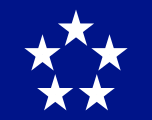
Officers with certain offices or billets, as well every bit all generals and admirals, have a personal flag assigned to stand for their potency and/or command;[12] thus why they are oft referred to as "flag officers". Aground, they are normally displayed inside the owner's office or raised on a secondary flagstaff near the unit colors; while they are flown aboard ship according to rank. The appearance consists of a number of stars equal to the officer'southward rank insignia, the colors determined past service: red with white stars for the Army and Marine Corps, bluish with white stars for Naval commanders and Air Force. Certain staff and non-line officers have unique colors: white with blue stars for not-command Navy admirals,[thirteen] while Army chaplains and medical generals use ecclesiastical purple and maroon backgrounds, respectively.[xiv]
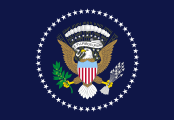
Unique flags are given to the President[xv] (due to his position equally Commander-in-Master[16]), Vice President, Secretary of Defense, Deputy Secretary of Defense, Under Secretaries of Defense, and Assistant Secretaries of Defense force,[17] each of the Secretaries of the Military Departments (Secretary of the Army, Secretary of the Navy, Secretary of the Air Force), Under Secretaries of the Armed forces Departments (Under Secretarial assistant of the Ground forces, Under Secretarial assistant of the Navy, Under Secretary of the Air Forcefulness), and Assistant Secretaries of the Military Departments (Assistant Secretary of the Ground forces, Assistant Secretary of the Navy, Assistant Secretary of the Air Force), the Chairman of the Joint Chiefs of Staff, Vice Chairman of the Joint Chiefs of Staff and Senior Enlisted Advisor of the Articulation Chiefs of Staff, and the primary of the Military Services (Chief of Staff of the Ground forces, Commandant of the Marine Corps, Chief of Naval Operations, Chief of Staff of the Air Force, and Commandant of the Coast Guard). An admiral, acting commodore, or Convoy Commodore aboard a send each may fly a flag from their flagship.
In improver, the Navy volition display the flag of the Secretary of Country when he or she is embarked equally the representative of the The states. Other diplomatic personnel are besides afforded a consular flag when embarked. The Declension Guard, being part of the Section of Homeland Security, will utilize the Secretary's flag much similar the Navy will utilize the SecDef's.

-

-

-

Flag of a The states Under Secretary of Defence





Others [edit]
Many other flags are traditionally associated with the military.
American Revolution [edit]
Not having made an official design until 1777, numerous singled-out flags were carried into battle past American forces. Even subsequently, the vague wording of the Flag Resolution of 1777 led to many designs.
- The virtually commonly carried pre-1777 flags was the Grand Union Flag, resembling closely the flag of the British East India Company.
- The Gadsden flag was created from a political cartoon, it was starting time seen carried into battle by Continental Marines.
- Fable holds that the Betsy Ross flag was the first version of the current American flag, and is depicted in artwork featuring Full general George Washington.
- The Francis Hopkinson version is as well claimed to be the first flag carried into boxing by American troops.
- The Serapis ensign was flown from the captured HMSSerapis due to the loss of the standard ensign during the Battle of Flamborough Head.
- The Cowpens flag was depicted as being carried by the 3rd Maryland Regiment at the Battle of Cowpens (while proven that the unit was not at Cowpens, the proper noun and pattern remained popular).
- The Bennington flag is ordinarily held to have been carried past American troops at the Boxing of Bennington.
- The Guilford Courthouse flag was carried by the North Carolina militia at the Battle of Guilford Court House.
- Several versions of the Flag of New England were carried past New England militias, especially noted at the Battle of Bunker Hill.
- The Pine Tree Flag found some express apply as a jack by early Naval vessels and boats.
- The Bedford Flag was one of the first battle standards of the American military.
- The Brandywine flag was carried by the 7th Pennsylvania Regiment at the Boxing of Brandywine.
- The 2d Canadian Regiment, non existence American, carried their own flag into battle when fighting for the Continental Ground forces.
- The Commander-in-Chief's Guard carried a unique imprint while they protected General Washington.
- The Flag of the Greenish Mountain Boys was the battle color of the Green Mount Boys and the Vermont Republic prior to its access to the Union.
Others [edit]
- The Star Spangled Banner Flag or Great Garrison Flag was flown over Fort McHenry during the Boxing of Baltimore in the War of 1812, inspiring Francis Scott Key to write the poem "The Star-Spangled Imprint". It ultimately became the U.S. national anthem.
- A flag proclaiming "Come and take it", in reference to a cannon the Mexican Army was attempting to seize, was fashioned by Texans at the battle of Battle of Gonzales.
- The brief being of the Confederate States of America yielded the creation of several flags used by the Amalgamated Army and Navy.
- The Fort Sumter Flag gained significance for its unique canton and its lowering at the Boxing of Fort Sumter.
- One-time Glory gained fame in the story of Captain William Driver keeping information technology prophylactic from Amalgamated capture and somewhen became the nickname for the Flag of the United States itself.
- The POW/MIA flag became a symbol of concern most military personnel taken as prisoners of war and missing in activeness.
- Recipients of the Medal of Honor also receive a flag based upon the design of the ribbon.
- The Air National Guard uses a unique flag in addition to the Air Force flag.
- The United States Coast Guard Auxiliary uses a flag based on the flag of the United States Coast Guard.
- The Civil Air Patrol uses a flag based on the Air Strength flag.
- "Don't Surrender the Ship", words on the battle flag of Oliver Take a chance Perry aboard the brig USSNiagara in 1813.
- The United States Space Control uses a unique flag along with the flags of the service flags.
Meet also [edit]
- Guidon (United States)
References [edit]
- ^ Duncan Jr., Charles West. (Oct 31, 1977). "DoD Directive 1005.viii". Deputy Secretary of Defense force. Department of Defense. Retrieved 2009-04-07 .
- ^ Terrel, Captain. "United states War machine Order of Precedence". veteransinfo.net. Archived from the original on 2008-x-11. Retrieved 2009-04-07 .
- ^ www.whitehouse.gov
- ^ Wyatt, Rick (2008-04-26). "Order When Displayed". Flags of the World. Retrieved 2009-04-07 .
- ^ Frequently Asked Questions Folio Archived 2006-05-03 at the Wayback Machine
- ^ American Naval Flags of the Revolutionary War
- ^ Civitillo, Susan (2002-09-09). "All U.Southward. Navy Ships to Begin Flying Showtime Navy Jack on Patriot Day". Usa Navy. Archived from the original on 2009-04-27. Retrieved 2009-04-07 .
- ^ Affairs, This story was written by Primary of Naval Operations Public. "Navy Returns to Flying Union Jack". www.Navy.mil . Retrieved 23 Feb 2019.
- ^ "The Colors of a Navy and Nation". The Sextant.
- ^ [ane] [ dead link ]
- ^ Wyatt, Rick (2004-07-10). "Military Rank Flags (U.S.)". Flags of the Earth. Retrieved 2009-04-07 .
- ^ Gregg, Thomas M. (July 28, 2010). "Us Navy: Current Position & Rank Flags". Annal of the Colors. War Flags. Retrieved 19 September 2010.
- ^ Gregg, Thomas Thou. (July 28, 2010). "United States Army: General Officers' Rank Flags". Archive of the Colors. War Flags. Retrieved xix September 2010.
- ^ Wyatt, Rick (2006-01-21). "President (U.South.)". Flags of the World. Retrieved 2009-04-07 .
- ^ History of the President's Flag Seaflags
- ^ US DOD Positional Colors
External links [edit]
- The Institute of Heraldry, U.S. Ground forces
- Military Flags (U.S.) at Flags of the World
cunninghampeenionved.blogspot.com
Source: https://en.wikipedia.org/wiki/Flags_of_the_United_States_Armed_Forces
0 Response to "Furled Flag Clip Art Combined Branches Military Service Symbol"
Post a Comment