Can Reading to Animals Help Child's Development
Since COVID-19 hit British shores, 3.2 1000000 pets take reportedly been purchased. Animals provide a valuable sense of companionship and a wide variety of species, including dogs, cats, fish, birds and horses take helped many people cope psychologically through the pandemic.
For educators searching for ways to help children cope, and to deal with the potential impact on their language and communication skills, animals may provide some artistic solutions.
As an educator and specialist in the interest of animals in schools, my inquiry shows how children'southward social and emotional evolution tin can benefit from interactions with animals, merely as well looks at how nosotros can ensure that the wellbeing of learners and animals is considered.
Social and emotional benefits
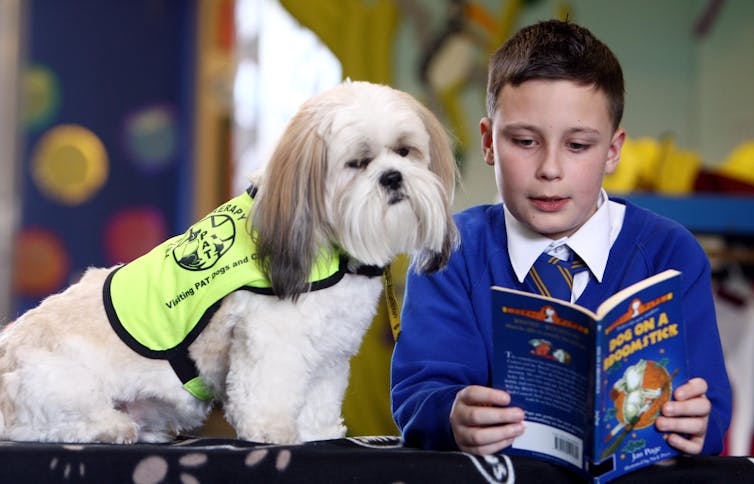
I written report we conducted involved trained dogs and their handlers doing weekly sessions in vi main schools in south Wales. Over the course of a term, pupils betwixt the ages of five and ten, whom teachers had identified every bit needing assist with their reading skills, spent 15 minutes at a time reading out loud to their canine companions, and reported improved self-confidence. This correlates with wider research into how reading-to-dogs schemes motivate children to selection up a book.
In another study we mention in our book Tails from the Classroom, the regular presence of a golden retriever called Honey helped pre-schoolhouse children showtime conversations with i some other, with adults and, of course, with Honey herself.
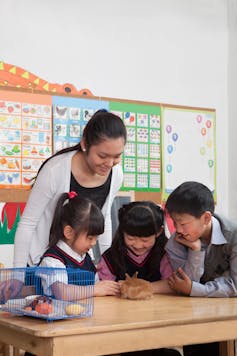
As role of this research, we talked to teachers from around the earth to detect out how animals – including a rabbit called Peter Pudding and a crew of maggots, snails and collywobbles – are supporting learners at every age and stage of development. A highlight was Daisy and Chip, a pair of geese, who hatched in a primary school in south Wales, where 4- and five-year-olds delighted in caring for them. The children learned to be kind and considerate when dealing with these infant animals, and developed their communication, observational and thinking skills as they watched them grow.
Our current research suggests a growing number of schools are seeing the benefits of having a resident school pooch or doing sessions with organisations such as the Kennel Club. This reflects non only the long-lasting emotional ties dogs can class with humans but their desire to please, their adaptability and their responsiveness.
Ethical considerations
But bringing an animal into school is not a conclusion to take lightly. For understandable reasons, mainly ethical, organisations including PETA do non support the use of animals in classrooms.
Clearly, ensuring the health, safe and wellbeing of all concerned is crucial, which adds responsibleness – and a potential crusade of stress – for teachers, already juggling complex classroom environments.
Some children may harbour fears or anxieties relating to animals. And at that place are likewise potential medical or cultural factors to consider.

So earlier bringing an animal into school, y'all need to practise your research. Which blazon of animal is all-time suited to the setting? What sort of intervention is possible with that species?
And beyond the species, you lot need to select the private beast itself. A dog might seem ideal, simply each has its own personality. How will you appraise whether this particular canis familiaris is happy in this detail classroom with these particular children?
Teachers also need to complete a detailed take a chance assessment, and have a programme for what happens after the lessons. Before Daisy and Chip arrived, the teacher carefully researched how to hatch goose eggs. She prepared her classroom environment and planned what would happen to the birds every bit they grew. Every bit a upshot she at present has 2 large adult geese in her garden (and possibly for the next xv years).
Choices and voices
Interventions involving sentient creatures should accept the form of a partnership. Animals should exist seen not equally tools or resources, but as individuals. The all-time animal-assisted interventions harness the bail between animal and human based on trust, knowledge, agreement and respect.
Beyond simply meeting the dog's bones needs, it is important to take into account how to enrich their experiences and wellbeing too. Risë Van Fleet and Tracie Faa-Thompson, founders of the Fauna Assisted Play Therapy organisation, propose that whatever intervention should consider what they telephone call the choices and voices animals have.
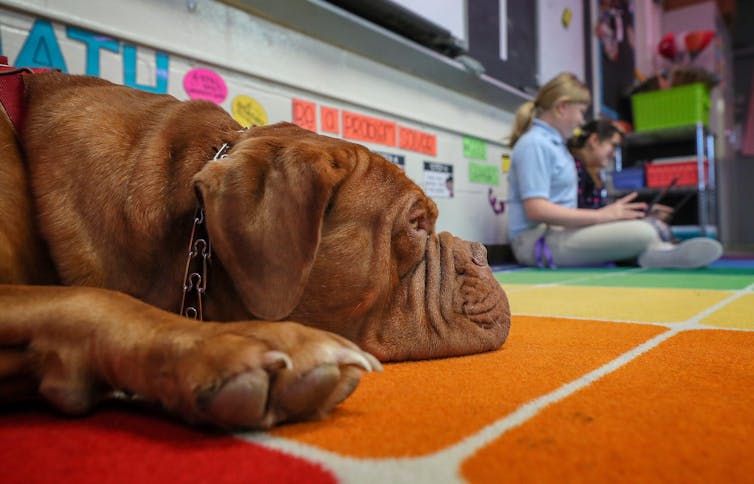
Approaches such as Van Fleet'due south prioritise playful, natural interactions. A well-mannered, well-trained dog who is tolerating a session is non necessarily a sign of a successful session. Instead, we demand to recall about how the dog might also enjoy themselves and, maybe, acquire from the experience likewise, as evidenced through their curiosity, engagement and willing participation.
Animals have sophisticated communication systems and nosotros need to learn about these if we are to "hear" what they're saying. With dogs, for case, a wagging tail is not ever the sign of a happy dog. And a bark tin can indicate excitement, fearfulness, surprise, frustration and more. Yous have to listen for pitch, speed, spacing and book to work out what they are saying.
This is an exciting new field of inquiry. There's a lot of research still to be washed into how teachers tin become advocates for their animal partners, learning to understand what they are proverb and allowing them to make choices of their own during sessions. And into the benefits reaped, for both the children and the animals.
cunninghampeenionved.blogspot.com
Source: https://theconversation.com/how-school-pets-can-help-children-to-learn-and-read-160064
0 Response to "Can Reading to Animals Help Child's Development"
Post a Comment